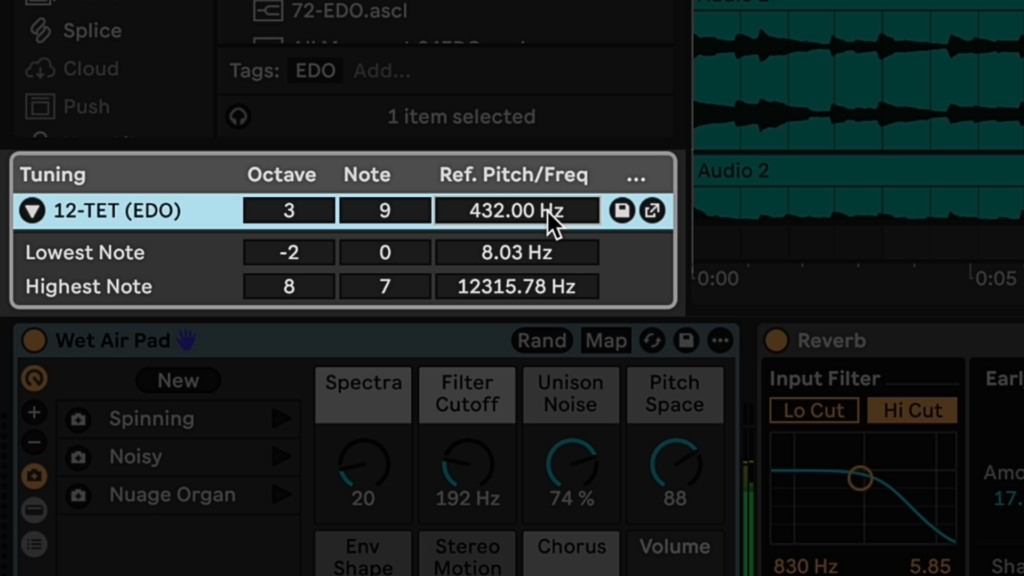


Music influences far more than just our mood in the literal sense — it can also trigger profound physiological processes within the body. For a long time, there has been debate about whether different musical tunings have varying effects on our wellbeing. In particular, the comparison between the traditional 440 Hz tuning and the alternative 432 Hz tuning has recently attracted increasing scientific attention. This article presents four studies examining the influence of these two tunings on physiological parameters, anxiety and stress, the autonomic nervous system, and cognitive performance.
1. The Influence of Musical Tuning on Cognitive Performance
A 2019 study¹ analyzed the influence of different musical tunings on cognitive performance. Participants underwent a series of standardized cognitive tests — covering attention, cognitive flexibility, and creativity — both before and after listening to music tuned to either 432 Hz or 440 Hz.
The results showed that participants who listened to music at 432 Hz performed significantly better on the cognitive tests than those exposed to the 440 Hz tuning. In particular, their problem-solving ability and creative thinking improved. These effects are thought to stem from optimized brain activity, supported by the relaxing and harmonizing qualities of 432 Hz. As such, the 432 Hz tuning may not only offer emotional benefits but could also positively influence cognitive function by promoting an optimal mental state.
2. Effects of 432 Hz versus 440 Hz on the Autonomic Nervous System
This study² focused on how different musical tunings affect the autonomic nervous system. By measuring heart rate variability (HRV) — a recognized indicator of the balance between sympathetic and parasympathetic activity — the researchers captured how listeners responded to music at 432 Hz compared to 440 Hz. A crossover design allowed for direct comparisons within the same participants.
The results showed that music at 432 Hz produced a significant increase in HRV, indicating a more intense parasympathetic activation and thus a deeper relaxation response. In contrast, the 440 Hz tuning led to less pronounced changes in HRV. These findings suggest that the natural resonance of 432 Hz may align more closely with the body’s physiological rhythms, potentially contributing to improved stress management and a more balanced autonomic nervous system over time.
3. The Influence of 432 Hz Music on Anxiety and Stress in Patients
This 2021 study³ examined how music tuned to 432 Hz affects the experience of anxiety and stress in patients. In a controlled experiment, participants were divided into two groups: one group listened to music at 432 Hz, while the comparison group listened to music at 440 Hz or no music at all. To quantify the effects, both subjective anxiety scores using validated questionnaires and physiological parameters such as heart rate, blood pressure, and cortisol levels were recorded.
The results showed that participants who listened to music at 432 Hz had significantly lower scores across anxiety and stress indicators. Specifically, lower heart rate and blood pressure were measured, and cortisol levels were notably reduced — a sign of stronger activation of the parasympathetic nervous system. These findings suggest that the 432 Hz tuning can effectively support emotional regulation and stress reduction, which is of particular therapeutic interest for patients in high-stress situations.
4. Comparative Analysis of the Effects of 443 Hz vs. 432 Hz Music on Cancer Patients
This new German study from 2024⁴ investigated the influence of music tuned to 432 Hz compared to 443 Hz, specifically in cancer patients. The focus was on physiological and emotional parameters of particular importance to patients in a sensitive health condition.
The study found that patients who listened to music at 432 Hz showed significantly better stress parameters than those exposed to music at 443 Hz. Specifically, lower heart rate and blood pressure values were observed, indicating a deeper state of relaxation. In addition, patients subjectively reported greater wellbeing and a more intense sense of inner harmony when in the 432 Hz condition.
These results suggest that music tuned to 432 Hz may resonate more naturally with the body’s own vibrations — a factor that can be especially significant for cancer patients, who often suffer from high stress and elevated physiological strain. The study implies that the slightly altered tuning at 443 Hz may be less conducive to stress reduction and the promotion of emotional balance than 432 Hz.
Although further research is needed to deepen these findings, the study offers valuable insights into the potential of 432 Hz music as a complementary, non-invasive measure to support the wellbeing of cancer patients.
Conclusion
The studies presented here offer fascinating insights into the influence of musical tuning on our physical and psychological wellbeing. From the positive effects on cognitive performance in 2019, to the optimization of the autonomic nervous system in 2020, to the significant reduction of anxiety and stress in 2021 — all of these findings suggest that the alternative 432 Hz tuning is often superior to the traditional 440 Hz. Particularly impressive are the most recent findings in cancer patients, which suggest that 432 Hz tuning can contribute to better physiological and emotional regulation even in critical health contexts.
If your curiosity has been sparked, it is well worth experiencing the sonic difference for yourself. On my website you will find not only music pieces precisely tuned to this harmonic frequency, but also the opportunity to book a personalized sound journey — one that helps you unlock the full potential of these sounds and bring greater harmony to your everyday life.
References:
- Musical Tuning and Cognitive Performance
PubMed (2019) ↩︎ - Effects of 432 Hz versus 440 Hz on the Autonomic Nervous System
PubMed (2020) ↩︎ - Influence of 432 Hz Music on Anxiety and Stress
PubMed (2021) ↩︎ - Comparative Analysis of the Effects of 443 Hz vs. 432 Hz on Cancer Patients
ResearchSquare, Version 1 (2024) ↩︎