
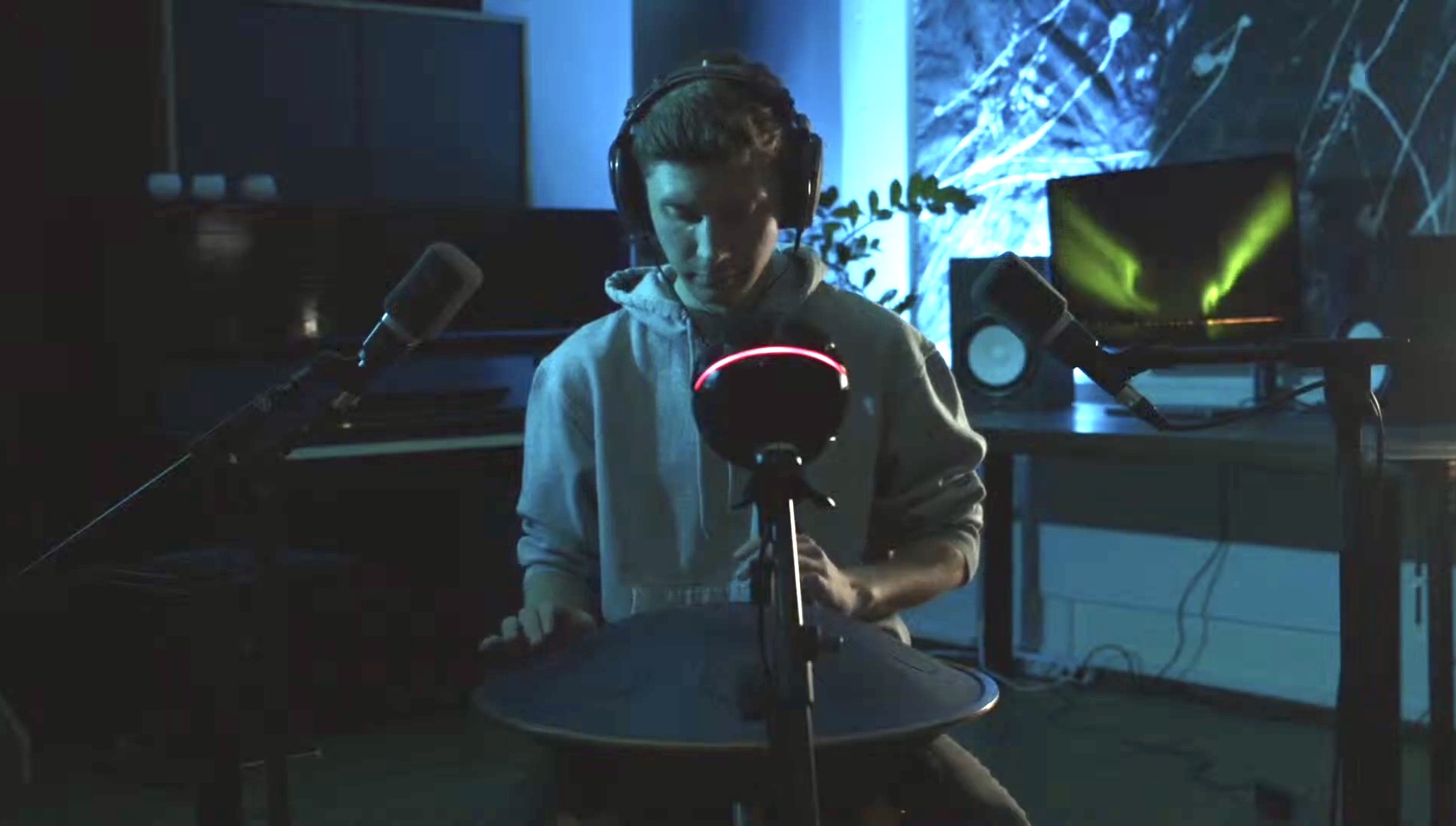
March 2024, me sitting in my basement in Germany, the handpan in front of me, a few microphones around me – in the meanwhile my family one floor higher laying in bed with headphones on, another part of the family in a different house, tuned into the same zoom meeting, my friends all across europe, all of them receiving the same intention and the same healing energy from me and my handpan. Played into two little microphones and broadcasted through zoom into the world wide web.
For me, this session was a test run. I just graduated from my sound healer training, tested out different recording setups and then invited family and friends to join me. I realised only later when they gave me feedback, that for them it was a full sound healing session. They received all the energy, felt the goosebumps on their skin, felt safe with the sound and could go very deep within.
I knew I was on to something big: recording sound baths from the comfort of your home – ready to be streamed all around the world. Not limited to room sizes, not limited to time preferences – they can join from their favourite place in the world at any given time.
‘Sound healing recordings always sound flat and lifeless.’
You’ve probably heard this, maybe even experienced that by yourself – joined a zoom session, didn’t feel anything, just heard the speakers cranking with the resonance of a singing bowl.
Here’s what’s actually happening when a sound bath sounds flat:
In most cases, it’s a setup problem. The wrong microphone, positioned incorrectly, in a room that’s working against the sound. That’s easily fixable.
But sometimes – and this is what most people miss – it’s not the recording at all. It’s the playback. A sound bath recorded beautifully, but played through laptop speakers. It’s clear that this will sound thin and lifeless every time. That’s not the recording’s fault. Laptop speakers cannot reproduce the depth, the width, the low frequencies that make sound healing feel immersive. They strip it out entirely.
The test is simple: listen to the same recording through high-quality headphones. If it comes alive – the recording is fine. The speakers were the problem.
There is also a technical mistake that causes more “flat” recordings than any other, and almost no sound healer knows it exists. It’s called phase correlation. When you record in stereo – which you should, always – two microphones need to be positioned correctly relative to each other. When they’re not, the signals partially cancel each other out. The result is a sound that feels hollow, narrow, strangely unreal. Done right, a stereo recording places the listener inside the room as if they were lying right there with you.
The technology to record a sound bath that sounds exactly like a real session, already exists. We just need to use it correctly.
Does healing actually work through a recording?
Before we talk about microphones and settings, let’s address the deeper question. Because for many sound healers, the technical side is secondary to this one: can the healing actually reach someone through a recording?
In most cases – yes. And I say this both from experience and from a scientific standpoint.
Most sound healing work operates through energy, intention, and the field that a practitioner creates when they play. That field is set at the moment of recording. The listener who presses play an hour later, or a week later, from the other side of the world – they are tapping into that same field. Non-locality means the energy is not bound to the moment and physical location it was created. It is always there, always accessible, when someone is ready to receive it.
There is one exception worth naming honestly: physical vibration. When you press a tuning fork to someone’s spine, or place a bowl on their body, the mechanical vibration moves through tissue and bone. That cannot travel through headphones. It requires direct contact. If that specific modality is your work, recordings will always be a partial experience.
But for most of what happens in a sound bath – the frequencies, the energy, the intention, the held space – a recording is not a lesser version. It is simply a different delivery. And often, people find recorded sessions more intimate than live ones. They are in their own space. Comfortable. No driving across the city afterward. They can fall asleep exactly where they need to be.
The most important piece of gear you already own: your room
Before you touch any equipment – think about the room.
This is where most sound bath recordings go wrong. People spend hours researching microphones and then record in an empty living room or hallway and wonder why everything sounds flat.
The microphone captures the room as much as it captures the instrument. In person, your clients are aware of where they are – the reflections, the ambient sound, the hum of the building. It all feels natural because they are physically present in it. But your listener is somewhere else entirely – maybe in their bedroom in another country, in a completely different acoustic environment. When your room bleeds into the recording, it sounds wrong to them. Foreign. Like two places overlapping.
What you want is a room that adds as little as possible – quiet and acoustically soft enough that all they hear is the instrument.
What that means practically:
Close all the windows. This sounds obvious. It makes an enormous difference. The street outside, the neighbors, the distant airplane – these are constant low-level sounds that you stop hearing after a while. The microphone never stops hearing them.
Choose the softest room in your home. A bedroom with a mattress and pillows and curtains already does much of the acoustic work for you. A bathroom, a stairwell, an empty kitchen — these will fight you at every step. The hard surfaces create reflections that pile up behind your instruments and make everything feel cluttered and strange.
And here is the piece of practical advice that has made the biggest difference in my own recordings: record at night. Daytime is cars, children, delivery trucks, planes, lawnmowers. At night, it quiets down. Find the quietest window at your location and use it. Your room matters, yes – but the silence around it matters more.
Do this test before setting up any equipment: stand in your chosen room and clap your hands once. If you hear a sharp ring or a long decay – add soft materials before you do anything else. Pillows, blankets, curtains drawn closed, a mattress leaned against a wall. Treat the room first.
The container: you need to record more than just the instruments
Here is something I see constantly, and it changes everything when you understand it.
A YouTube video of someone playing singing bowls for an hour is not a sound bath.
It might be beautiful. It might be relaxing. But it is background music – not a session. And your listeners will feel the difference even if they can’t name it.
What makes the difference is you. Your voice. The container you set before the first instrument sounds.
Think about what happens when someone comes to you in person. You greet them. You introduce the session. You speak about what you’re holding space for, what the intention is. Maybe you say a few words that help them settle in, let the day fall away. And at the end, you bring them back. You close the space. They return to their body and to the room.
That arc – from arrival to return – is the session. The instruments live inside it.
When you record, record all of it. Introduce yourself. Name the intention. Speak briefly before you begin playing. And close it properly when you finish. This is what allows someone to lie down with headphones on and feel genuinely held – not just sonically stimulated.
Your voice is also technically different from your instruments. A large diaphragm condenser microphone will capture both well. But how you record them is worth thinking about – which brings us to equipment.
If you have no budget: start with your phone
Most people wait until they have the right setup, but the right setup never arrives.
If you want to record your first sound bath today, with no additional equipment, here is what to do:
Use your phone – but open the camera app, not Voice Memo.
Voice Memo usually records in mono. Mono collapses the entire stereo field into a single point. It sounds flat because it is flat. There is no width, no dimension, no sense of space.
Your camera app records video – and most modern smartphones, especially iPhones, record video in stereo (meaning left and right separately). The two microphones at different points on the phone create the spatial image that makes a recording feel immersive.
Position the phone as if you’re filming yourself playing. Prop it where the microphone faces your instruments. Press record.
It won’t be your best-ever recording. But it will be real. And real, consistent, honest work compounds over time in a way that waiting for perfect never does. Use what you earn from that first session to invest in the next piece of equipment.
Equipment: what actually moves the needle
When you’re ready to invest in a proper sound healing recording setup, here is the honest version – not the gear-obsessed version.
The microphone is everything. Not the audio interface. Interfaces, from a basic Focusrite Scarlett to something more expensive, all do the same essential job and sound virtually identical at this level of work. The microphone is where the character of your recording is shaped.
Avoid USB microphones. They have limited control, a noisier floor, and you cannot expand around them as your work grows.
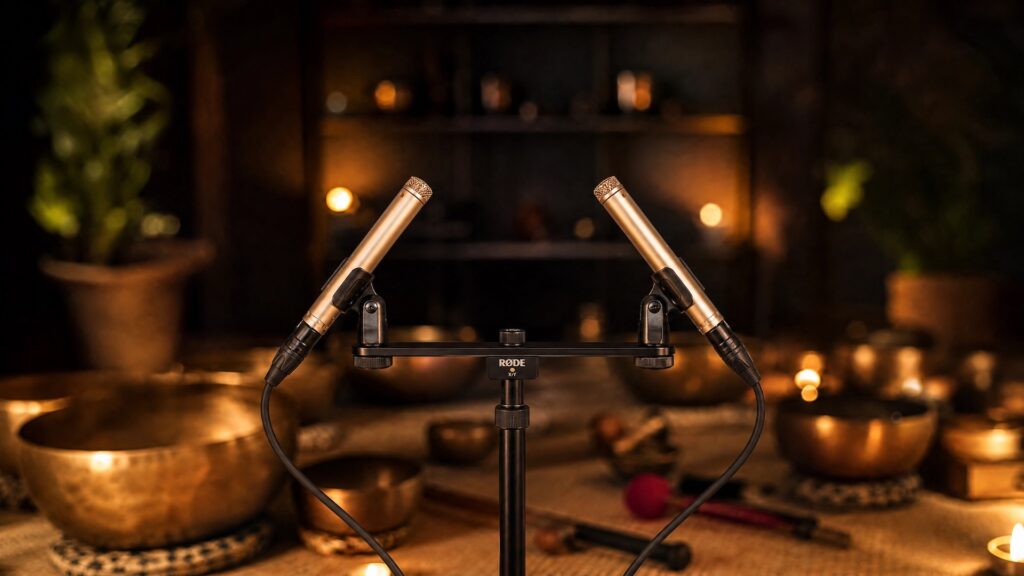
For most sound healing work, a large diaphragm condenser microphone gives you the warmest, fullest sound – it captures voice and instruments with the same richness. If you are only recording instruments (no voice in the same setup), a matched pair of small diaphragm condensers gives you an excellent stereo image as well.
Stereo is not optional. Two microphones, positioned correctly, create the sense of space that puts your listener inside the room. Mono – one microphone – collapses everything into a single point. That works well for voice only, but with sound baths your listener will feel it even if they can’t explain why.

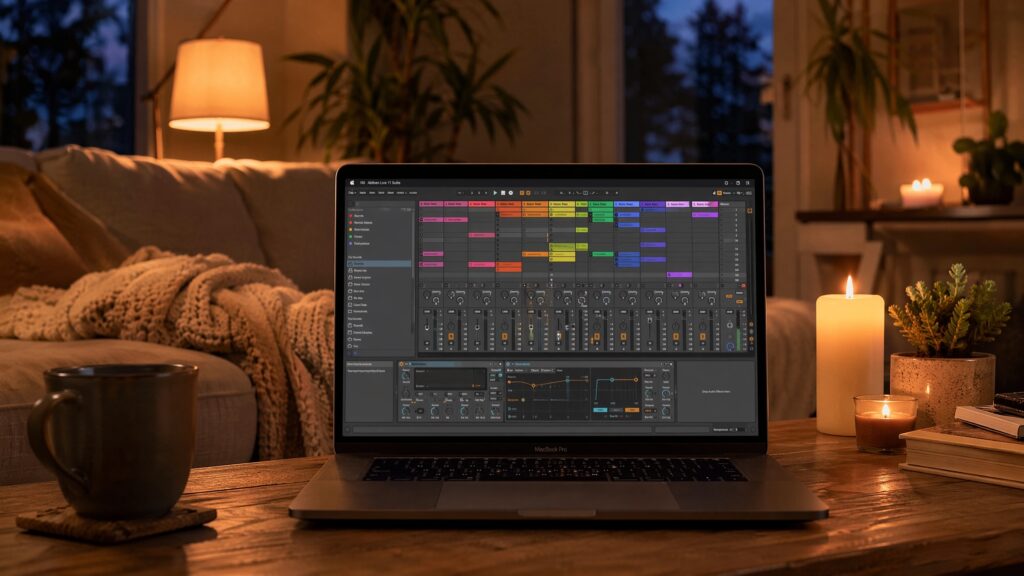
You do not need expensive recording software. GarageBand on Mac is free and handles multi-microphone recording well. Ableton Live has a free trial and is excellent for more complex setups. The software is not where the difference is made.
The signal chain: how to troubleshoot anything
Every recording setup follows the same simple path:
Instrument → Microphone → Interface or Mixer → Computer → Listener
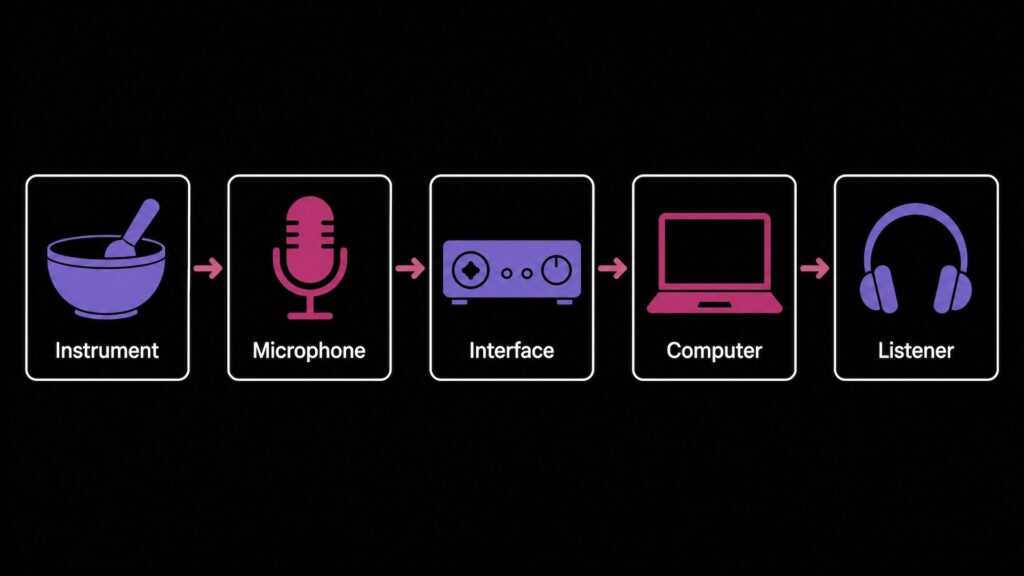
When something doesn’t sound right, check each step in order. The problem is always in the chain somewhere.
A few things that catch people off guard:
Large diaphragm condenser microphones need phantom power – 48V – to work. This is activated on your audio interface or mixer. Without it, you’ll get no signal or a very faint one. Small diaphragm microphones don’t need it.
Once signal is arriving at your interface, check that your recording software has selected the correct input. Many people have their laptop microphone active instead of their external one without realizing it.
And check your levels before every session. Play the loudest thing you’re likely to play during the recording. If the meter in your software ever hits red – you’re distorting. Back the gain down. Sound healing is quiet work. Leave space.
Before you record your sound bath: the checklist
- Choose your room – soft, quiet, away from street noise
- Close all windows and doors
- Wear clothes that don’t rustle
- Connect up equipment, activate phantom power if using large diaphragm condensers
- Open your recording software, confirm the correct input is selected
- Play through everything – check signal arrives at every step in the chain
- Do a 2–3 minute test recording
- Listen back on headphones – is there background noise? Distortion? Clothing sound?
- Restart your computer and confirm the setup still works
- Press record – and don’t adjust levels mid-session
That last one matters more than people think. A small adjustment mid-session is audible. The listener feels the shift even if they can’t identify it. Set your levels before you begin. Then leave them.
The goal is a recording where the listener forgets they are listening to a recording.
For live online sessions: Zoom
If you’re running live sound healing sessions on Zoom rather than pre-recording, there’s one thing you need to understand about how Zoom works by default.
Zoom is designed for speech calls. It compresses audio to keep the connection stable, automatically reduces background noise, and applies processing that makes voices sound clear on any internet connection. All of that is actively destructive for sound healing, which needs the full frequency range intact.
The fix:
In Zoom’s audio settings, enable Original Sound (also called Music Mode in some versions). This tells Zoom not to process the audio. Then set the audio quality to the highest available option, and disable automatic noise suppression.
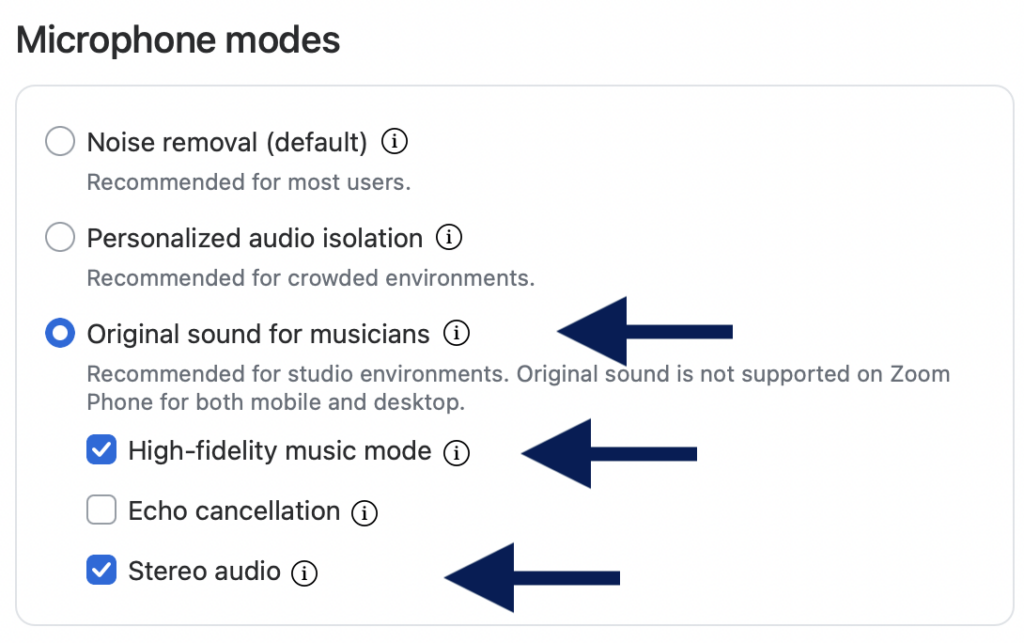
Also: test your connection before every live session. Stable Wi-Fi only – not mobile data. Call a friend on the Zoom link ten minutes before going live and listen to how you sound on their end. And confirm inside Zoom that the correct microphone is selected – not your laptop’s built-in mic.
Your listeners are about to close their eyes and trust you to hold them for the next hour. The setup should be invisible. It should just work.
One more thing
I have heard people say the magic doesn’t translate through a recording. That you need the physical presence, the room, the living moment.
I understand why they say it. I felt that uncertainty myself before I pressed record for the first time.
But what I have experienced – both as a facilitator and as a listener – is that when the setup is done with care and the intention is held with the same presence you would bring to a live session, the healing arrives. Not as a lesser copy of the real thing. As its own real thing.
Your listener is lying in their bed with headphones on. The city has gone quiet. The sound moves through them. You recorded this three weeks ago in your basement, and none of that matters – because the field you were in when you played is still there, and they just walked into it.
That’s worth recording.
Frequently Asked Questions
Can you record a sound bath with just your phone?
Yes. Open the camera app – not Voice Memo. Voice Memo records in mono, which sounds flat and narrow because it collapses the entire stereo field into a single point. Your camera app records in stereo, capturing the spatial quality that makes sound healing feel immersive. It won’t be your best-ever recording – but it’s a real starting point, and a real starting point is worth more than waiting for the perfect setup.
What microphone do I need to record singing bowls and gongs?
For most sound healing work, a large diaphragm condenser microphone gives the warmest, fullest sound – it captures both voice and instruments well. If you’re recording instruments only, a matched pair of small diaphragm condensers positioned as a stereo pair is excellent. Avoid USB microphones – they have a noisy floor and limited control. And always record in stereo. Two microphones, positioned correctly, are what create the sense of space that puts your listener inside the room.
Do sound bath recordings actually work energetically?
In most cases, yes. The energy field and intention held by the practitioner at the moment of recording remains accessible to listeners whenever they press play – non-locality means the healing is not bound to the physical moment it was created. The one exception: physical vibration like tuning forks pressed directly to the body cannot travel through headphones. But energy-based healing, frequencies, and intention travel just fine. Many people find recorded sessions more intimate than live ones precisely because they receive it from their own space, in their own time.